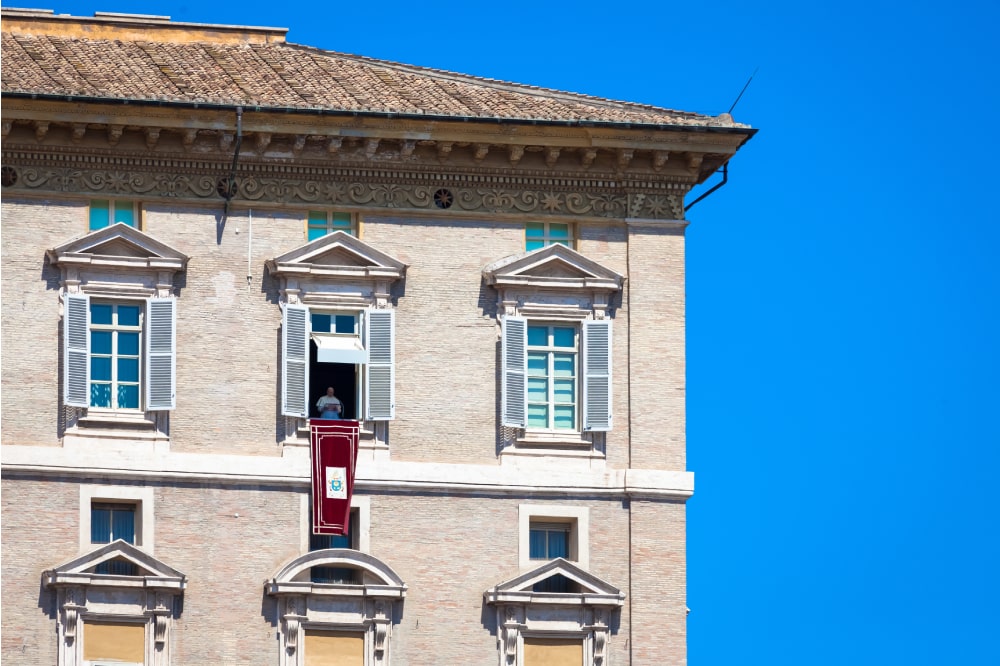
We often hear about the Sunday Angelus recited by the Pope, a kind of apostolic blessing that the Pontiff imparts from the balcony every Sunday at noon to the faithful gathered in the square in front of St Peter’s Basilica. In reality, the Angelus is much more than that. It is an important prayer for Catholic Christians, who should recite it three times a day: at dawn, at noon, and at sunset. Each of these moments is marked by the ringing of church bells.
The Angelus is, in particular, a prayer of thanksgiving dedicated to the Virgin Mary, Mother of Jesus, for having accepted within herself the mystery of the Incarnation.
To fully understand the importance of the Angelus prayer, we must retrace the history of Revelation, focusing on the figure of Mary of Nazareth and the account of the Annunciation.
In the sixth month, the angel Gabriel was sent by God to a town in Galilee called Nazareth, to a virgin betrothed to a man of the house of David, named Joseph. The virgin’s name was Mary. (Luke 1:26-27)
This passage refers, of course, to the moment when Mary accepted to conceive Jesus, the Son of God—a mystery that Christians call the Incarnation, when Jesus took on human nature while remaining fully divine. This is known as the Hypostatic Union, meaning that Jesus assumed human nature without ever ceasing to be God. It is as if, at that moment, human nature was added to His divine nature, making Jesus Christ fully God and fully man at the same time. In this interpretation of the Annunciation and the Incarnation, the Virgin Mary is, in every sense, Theotókos, the Mother of God.
The Angelus Prayer
The Angelus prayer itself consists of three verses and their respective responses. The first verse is also the one that gives the prayer its name:
℣. Angelus Domini nuntiavit Mariae.
℟. Et concepit de Spiritu Sancto.
℣. Ecce ancilla Domini.
℟. Fiat mihi secundum verbum tuum.
℣. Et Verbum caro factum est.
℟. Et habitavit in nobis.
After each verse, a Hail Mary is recited, and at the end, the prayer is usually concluded with three Glorias, followed by an Eternal Rest and, if desired, an Angel of God prayer.
During the Easter Season, up to the feast of Pentecost, the Angelus is replaced by the Regina Coeli (Queen of Heaven) prayer, dedicated to the Madonna in celebration of the Resurrection of Her Son, Jesus Christ. The Regina Coeli is also recited three times a day.
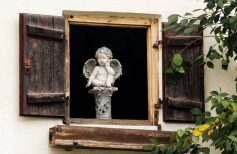
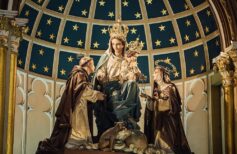
Statue in painted maple wood, handmade by the artisans of Valgardena according to the local artistic tradition.
It is likely that the practice of the Angelus began to spread during the medieval period, within the Liturgy of the Hours. Monks would chant psalms and antiphons at various times of the day, also for the benefit of those who could not read or write and would simply listen and pray.
The official establishment of the Angelus is attributed to Pope Urban II, who, in 1095 at the Council of Clermont, promoted its diffusion after the victory of the Crusader army against the Turks. Pope Callixtus III also contributed to the consecration of this special Marian prayer in 1456, again as an invocation of the Virgin Mary’s intercession in wars against the Turks. It was later King Louis XI of France who, in 1472, decreed that the Angelus should be recited three times a day.
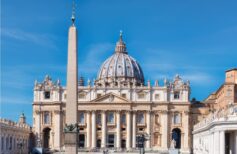
The Pope’s Angelus in St Peter’s Square
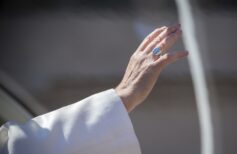
As for the Angelus recited by the Pope every Sunday at noon in St Peter’s Square, it is usually preceded by a short address from the Pontiff, in which he reflects on contemporary issues and global concerns. This address is broadcast worldwide by various television networks.
Since 1954, the recitation of the Angelus has been transmitted via radio and later on television. The first Pope to embrace this initiative was Pius XII, following the insistence of Luigi Gedda, publisher and president of Catholic Action.
Anyone can attend the Angelus by going to St Peter’s Square at the appointed time every Sunday.
The Angelus with Pope Francis
Like his predecessors, Pope Francis places great importance on the Angelus, seeing it as an opportunity for encounter and dialogue with the faithful.
During the pandemic, when lockdowns brought eerie and unsettling images of an empty St Peter’s Square, and now in the face of the war in Ukraine, Pope Francis’s Angelus has become more than just a papal blessing. It is not only a moment of prayer but also a heartfelt appeal from the Pontiff to the goodness and justice within humanity—a call to make one’s existence a tool of faith and mercy, just as Mary did in that most sacred moment of the Annunciation.
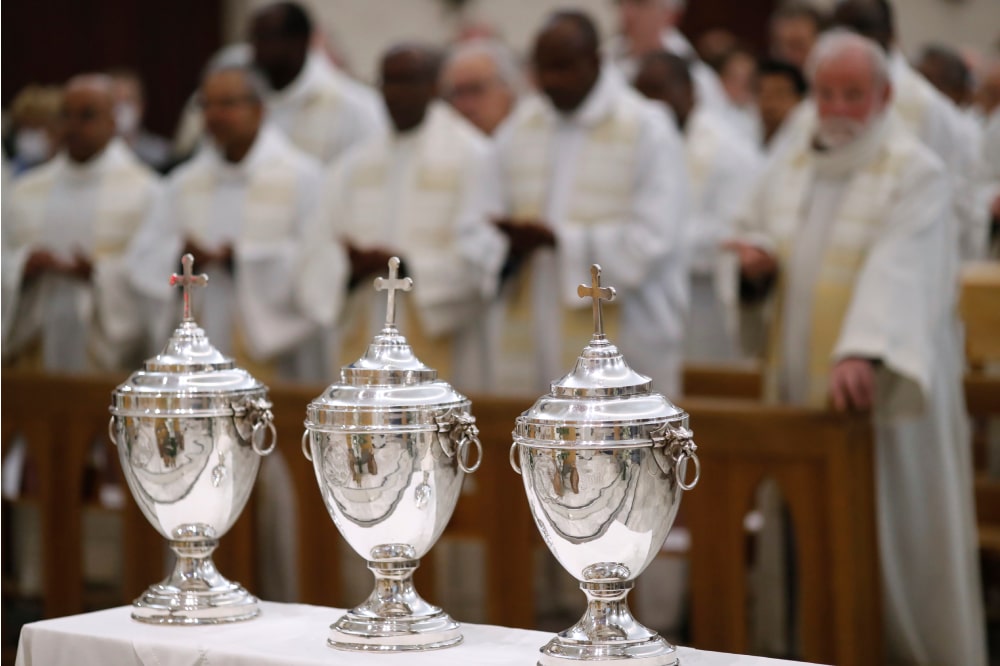
The chrism mass celebrates the mystery of the church, its unity and communion while waiting for Easter. It is also...
What’s the Future of Religion?
What’s the Future of Religion?
A Beginner’s Guide to Christianity
A Beginner’s Guide to Christianity
Mind-Blowing Statistics About Christianity You Need to Know
Mind-Blowing Statistics About Christianity You Need to Know
6359
Enter the Holyart world: $20 discount voucher valid on over 60,000 items
Come and discover Holyart, the largest e-commerce of religious articles in Europe and immediately receive a $20 voucher to use with your first purchase.
Check your mailbox: you will receive your discount within 5 minutes





 4 March 2026