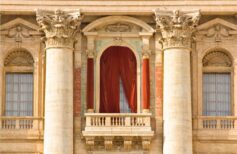
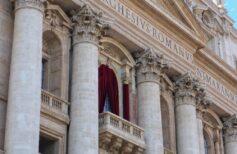
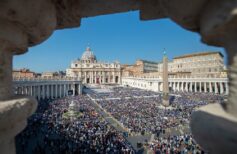
There was a moment, as the world waited in silence, when the bells rang and history began to flow once more, its mighty heart beating again. From the Loggia of the Blessings, where every new beginning takes on flesh and word, a voice broke the suspense with simple words, trembling with emotion: words of peace, words of gratitude. The name of Pope Francis, just spoken by the one who now inherits his legacy, echoed across St Peter’s Square like a breath of living memory: Pope Leo XIV, born Robert Francis Prevost. The new Pontiff did not hide his emotion. He spoke of Francis as a spiritual father, a gentle shepherd who had led the Church through times of unrest and hope. “I take up his legacy,” he said, “and with it, the dream of a poor, fraternal, pilgrim Church.” Just elected, with a soft accent and discreet step, he opened a new era, scented with continuity and prophecy.
Born in Chicago to a family interwoven with European roots, the first American Pope in history presents himself as a man of the frontier, a bridge between worlds, between cultures, between ages. With his heart turned to the peripheries of the soul and a gaze able to glimpse tomorrow’s challenges, Leo XIV is called to lead God’s people in the fragile and bold time of the third millennium. And he does so with the humility of one who knows he is not alone, for every step he takes carries the footprints of those who came before.
His is a profile that unites roots, rigour and breadth: a mind shaped by logic and theology, a heart forged through contact with poverty, a spirit tempered in Augustinian fraternity. His figure naturally embodies the balance the Church invokes today: between institution and people, between Tradition and the questions of the present, between the unity of faith and the plurality of cultures.
The Origins and Identity of a “Quiet American Citizen” Pope
Robert Francis Prevost was born on 14 September 1955 in the metropolis of Chicago, the beating heart of an America able to cherish ancient traditions while gazing fearlessly into the unknown. His roots lie in a soil of interwoven stories: Italian-French-Spanish blood, languages and devotions chasing one another from one continent to another.
His surname is already a kind of interior geography, a call to origins that become universal vocation. Sometimes names carry with them an ancient echo, like a bell sounding from far away. The surname Prevost originates in France, where it once indicated someone called to lead, to oversee, to serve with authority and justice. It derives from the medieval term prévôt, used to designate officials who administered land, communities and sacred places on behalf of a lord or the king. Going even deeper, its Latin root praepositus holds the original meaning: “the one placed in front.” Not to dominate, but to guard. Not to command, but to guide.
Over time, that title became a name, and then a surname, passed down from generation to generation like a silent inheritance. It crossed the centuries, spread through the French regions of Normandy and Île-de-France, reflected in the dialects of Northern Italy, becoming Prevosto, Prevò, Provost, and in some Alpine valleys it came to mean the parish priest, the rector of the community, the one who watched over others’ lives.
One branch bends southward, through the valleys of Piedmont and the lakes of Lombardy, where languages intertwined like dialects and surnames crossed borders. Louis Marius Prevost, father of the future Pope, carried an Italian heritage, perhaps hidden in his maternal genealogy, in those mixed marriages uniting families from beyond the Alps with local ones, in a web of movement, porous borders and shared affection.
It is there, between Italy and France, that the name Prevost becomes a cultural bridge, then crosses the ocean to take root in America, like a seed carried on the wind of history. A mosaic of origins now composed in the gentle and resolute face of Leo XIV, a Pope of the borderlands, son of diverse lands and universal brother, with a vocation to responsibility, service and guardianship.
The family of Robert Francis Prevost embodies this interwoven story: a name from afar, familiar with courts and churches, countryside and cities, now echoing in St Peter’s Basilica as a sign of destiny. Prevost: a man “placed in front”, yes, but to be a servant, not a master. To stand among, not above. To build bridges, not thrones.
A Vocation Carved Through Time and Space
The calling, for Robert Francis Prevost, did not arrive like a sudden bolt of lightning, but like a line drawn patiently, step by step, between lecture halls and the world’s peripheries. Raised in the United States, he walked from an early age the path of the Order of Saint Augustine, imbued with contemplative spirituality and thirst for justice.
The first breath of his formation came in the Augustinian Minor Seminary, then expanded into the world of science and thought. In 1977, he graduated in Mathematics and Philosophy from Villanova University in Pennsylvania, a place where logic meets faith, and intellectual rigour opens to mystery.
That same year, he entered the Augustinian novitiate in Saint Louis, Missouri, embracing the Rule as a compass for the soul. He made solemn vows in 1981, sealing a choice that was not merely religious, but profoundly existential. He studied Theology at the Catholic Theological Union in Chicago, and later flew to Rome, the pulsating heart of Christianity, where he earned a doctorate in Canon Law with honours at the Pontifical University of St Thomas Aquinas.
In 1982, in a Rome still stirred by post-Council winds, he was ordaineda priest. But it was in 1980s Peru, among the dusty streets of Trujillo and the wounded faces of poverty, that the young Father Prevost underwent one of the most defining experiences of his life. For nearly fifteen years, he served as parish priest, prior, formator, judicial vicar, and lecturer in Patristics and Moral Theology. He taught, led, listened. He learned a language that was not just Spanish, but the universal language of compassion. The global South entered his blood and heart, shaping in him a pastoral approach rooted in closeness.
In 1999, he returned to the United States, becoming provincial prior of the Augustinian Province of Chicago. Two years later, in 2001, he was elected Prior General of the entire Order of Saint Augustine, a leadership role he held for twelve years, traversing continents and communities in a constant tension between contemplation and mission.
Under Pope Francis, his figure definitively emerged on the stage of the universal Church. In 2014, he was named bishop of Chiclayo, Peru, and later held important positions in the Roman Curia. Appointed a member of major Dicasteries, including those for Clergy and Bishops, he became in 2023 the Prefect of the Dicastery for Bishops and President of the Pontifical Commission for Latin America—key roles in discerning and appointing new pastors.
On 30 September 2023, Francis created him a cardinal, a gesture that already felt like a prelude.
He is the first Pope with a degree in mathematics. They already call him the “mathematical Pope,” and yet listening to him, there is nothing cold or abstract about him. Analysis, precision, clarity of argument—these are tools submitted to the light of the Gospel. Even in his first appearance, Leo XIV broke with tradition: he was the first to read from a prepared speech from the Loggia of St Peter’s—a small gesture, perhaps, but one that reveals a method, a vision. Every word counts. Every choice carries weight.
He has been called a reserved man, yet in the moments before his election, his humanity shone through with disarming power. Cardinals recall seeing him breathing deeply, overwhelmed by the call; one of them, Cardinal Tagle, offered him a sweet: a small gesture, immense tenderness. And when, at the decisive moment, the assembly rose to acclaim him, he remained seated. Not out of pride, but out of holy fear: someone had to take his hand and help him rise.
The Road to the Chair of Peter
The election of Leo XIV came like a wind shifting direction without warning. The Conclave, suspended between expectation and prayer, saw three names rise: Pietro Parolin, the face of Vatican diplomacy; Peter Erdo, a theological stronghold; and Robert Prevost, a silent presence filled with meaning.
Divisions among the Italian cardinals broke the old unity of their bloc, while the Erdo proposal, backed by more conservative voices, found insufficient resonance within the Sistine Chapel.
It was at the fourth ballot that the atmosphere truly changed. “The votes swung overwhelmingly towards Prevost,” recounted Cardinal You of Korea. A broad consensus, like a silent tide that envelops everything. Leo XIV emerged as a figure of synthesis: a bridge between eras, spiritual heir to Francis, a man able to speak to a world in transition.
When he revealed the name he had chosen—Leo XIV—he did so with the calmness of one who knows that every word is a promise. The reference was to Leo XIII, author of Rerum novarum, a prophetic voice in the time of the first industrial revolution. Today too, the new Pontiff said, we are living through another revolution: that of artificial intelligence, of new inequalities, of work that changes its shape and meaning.
His name is a declaration of intent, a bridge thrown between the questions of the past and those of the present. With the same strength as the Lion, this Pope wants to defend human dignity, proclaim the value of work, and listen to the voiceless. And in doing so, he places the Church within the great dialogue between humanity and its future.
His vision is clear: just as Leo XIII spoke to his time with words of justice, so Leo XIV seeks to offer our age criteria for discernment. Artificial intelligence, the transformation of labour, human dignity—these are the new frontiers of a social doctrine that cannot lag behind. “Every technology,” he has said, “must be measured by its ability to serve human beings, not to dominate them. Every advance must become a caress, not a wound.” In this light, the Church has the task of reminding the world that man is not a function, but a mystery.
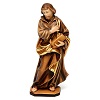
Statue of Saint Joseph depicted while working as a carpenter. Saint Joseph is the patron of carpenters,..
A Pontificate Marked by Peace and Reconciliation
“Peace be with you all”: with these words he began, like a universal embrace. But this is not the peace of convenience, that avoids conflict for the sake of comfort. His is a “disarmed and disarming peace”, a peace offered bare, and for that reason stronger than any army. A peace that challenges consciences, that builds bridges while the world raises walls.
The Pope is, in the original sense of the word, the one who unites the shores. And Leo XIV wants to be just that: a craftsman of encounters, a silent builder in a world that shouts.
“I am the unworthy successor of Peter,” Leo XIV said, and in those words echoed the humility of the greats. His gaze is turned to Tradition, but with eyes wide open to the frontiers. He declared his intention to continue “the precious legacy of Pope Francis”, walking a path of inclusion, synodality, listening. In his heart lives the spirit of the Second Vatican Council, a luminous compass for navigating uncertain times. His idea of the Church is that of a living body, where every voice has the right to be heard, and where authority does not impose but serves.
Pope Francis resin statue 30 cm.The statue of Pope Francis is made of colored resin. The Pope is depicted in an attitude…
The Augustinian Tradition as Compass
He quoted Saint Augustine: “With you I am a Christian, for you I am a bishop.” In these words lies the deep wisdom of one who understands the depths of the human soul. Just as Augustine lived through the fall of the Empire and the rise of a new world, so Leo XIV now guides the Church amid the ruins and promises of our own time. He is a bishop because he is a brother. Not a monarch, but a servant. Not a distant figure, but a presence beside.
He traced his journey in clear and luminous words: primacy of Christ, missionary conversion, synodality, attentiveness to the sensus fidei, popular piety, care for the least, dialogue with the world. Not a list, but a map of the heart.
At the centre, Christ. Not as a symbol, but as a living presence. And around him, a community that proclaims, listens, allows itself to be transformed. A Church unafraid of fragility, but dwelling within it as a place of grace.
The pontificate of Leo XIV opens like a door slightly ajar upon the future. Within, one glimpses faces, tears, hopes. A Church that walks, that allows itself to be questioned, that is not afraid to get its hands dirty. A Church that knows how to say “we”. With Francis’s breath in his heart, and the gaze of the poor in his eyes, Leo XIV begins his journey. He does so as one who carries a flaming torch, received with reverence and returned with fidelity. And in that flickering flame, which is both memory and prophecy, the face of the Church to come is already visible.
Jesus the Good Shepherd wood carved statue Val Gardena. Statue representing Jesus the Good Shepherd, painted with oil colours and finished with gold leaves…
The chrism mass celebrates the mystery of the church, its unity and communion while waiting for Easter. It is also...
What’s the Future of Religion?
What’s the Future of Religion?
A Beginner’s Guide to Christianity
A Beginner’s Guide to Christianity
Mind-Blowing Statistics About Christianity You Need to Know
Mind-Blowing Statistics About Christianity You Need to Know
6578
Enter the Holyart world: $20 discount voucher valid on over 60,000 items
Come and discover Holyart, the largest e-commerce of religious articles in Europe and immediately receive a $20 voucher to use with your first purchase.
Check your mailbox: you will receive your discount within 5 minutes









 4 March 2026