There is a road, made not only of stones and dust, but of choices, shadows, and redemption. Upon that road walked Bartolo Longo, a man who knew how to cross the darkest night to discover, within himself and in devotion to Our Lady, the flame of a rebirth.
Born in 1841 in Latiano, in the heart of rural Apulia, Bartolo was not always the saint we venerate today. His youth was marked by doubt, by searching, by downfall. In a restless Naples, hungry for spirituality, he let himself be seduced by occult philosophies and was initiated into Satanism, living through the darkest years of his soul. But, as often happens in predestined lives, a light was kindled when everything seemed lost: it was the encounter with the Rosary, with that simple and unyielding faith which for centuries has preserved the hope of the Christian people. Kneeling before Our Lady, Bartolo Longo found the path home. And it was in Pompeii, where misery was most savage and despair most suffocating, that he chose to be reborn.
Today, borne on the wings of the Supplica and within the walls of the Sanctuary of Pompeii, Bartolo Longo still speaks. His voice, woven of tears and laughter, of doubts and certainties, resounds in the hearts of those who seek, of those who rise again, of those who every day set out on their journey.
Announced for 19 October 2025, during the Jubilee, his canonisation will be far more than a rite: it will be the seal upon a story of downfall and resurrection which belongs to each of us. His spiritual legacy is the most powerful of invitations: never cease to pray, to rebuild, to hope.
Never surrender to darkness, for, as Blessed Bartolo Longo teaches, even from the blackest night can be born the brightest day.
Bartolo Longo was born in the heart of the South, where the red earth of Apulia mingles with the dreams and torments of generations. Yet, as often happens to great hearts, the road to light was, for him, shrouded in thick shadows. The son of a doctor and of a profoundly Christian mother, after his classical and legal studies in Lecce and Naples, Bartolo immersed himself in the restless atmosphere of nineteenth-century Naples: a time in which philosophical passions, political ferment, and the seductions of occultism roamed the salons and alleyways. A brilliant but troubled young man, Bartolo Longo was swept away by the fascination of mystery; he drew close to spiritism and esoteric circles, until he was initiated into Satanism, even becoming a “priest of Satan”. And yet despair devoured him, his mind wavering between dark visions and a sense of utter loss. In those nights of torment, his mother, constantly at prayer for him, seemed like a distant anchor. But it was precisely in that abyss that an encounter changed the course of his life: Don Alberto Radente, a Dominican with words both simple and profound, offered him the way of redemption. Bartolo then chose the hardest path: to climb back from the depths. He confessed, renounced the errors of the past, and, guided by the Rosary, re-embraced the Catholic faith. It was in this fierce struggle between shadow and light that Blessed Bartolo Longo became, for himself and for the world, a living symbol of a mercy without limits.
But the journey of redemption is never solitary. Every true conversion creates ripples, transforming places and lives it touches. After the inner deluge and the rediscovered salvation, Bartolo Longo remained in Naples, the city of a thousand contrasts, suspended between devotion and despair. He was a redeemed young lawyer, but his soul still found no rest. Amid the fervour of the metropolis, Bartolo became an apostle of his rediscovered faith: he visited prisoners, aided the poor, became the voice of those without a voice.
Yet Providence had for him an even broader design. It was here that he met a woman destined to be not only a partner in his works, but also a sister of the soul: Countess Marianna Farnararo, the young widow De Fusco. Marianna, a woman of deep faith and sensitivity, was herself engaged in helping the weak and generously administered some lands in the valley of Pompeii, then a forgotten place, plagued by malaria and marked by the darkest misery.
The meeting between Bartolo Longo and Marianna was like the spark that sets alight a sacred fire. United by the same thirst for charity, they began to work together to aid orphans and widows, to educate children without a future, to build small schools where before there had only been neglect.
Between them grew a profound spiritual friendship, an understanding that knew how to speak the language of the Rosary and of selfless love.
Bartolo Longo and the Sanctuary of Pompeii
The destiny of Bartolo Longo and of the Valley of Pompeii intertwined almost by chance, in 1872, when he was sent to take care of the administrative affairs of Countess De Fusco’s lands. But what he found went far beyond his expectations: the valley was a mosaic of poverty and abandonment, a place where countless lives survived on the margins, bereft of comfort and of future.
Even the small church, ancient heart of that community, lay in wretched condition, forgotten like its people.
It was in that context, amid silence and ruins, that Bartolo felt what seemed like a mysterious calling: an inner impulse urging him to change the destiny of that place. In a moment of deep solitude, while the countryside vibrated with the simple prayers of the humble, he intuited that his life must intertwine with that of Pompeii through the Rosary. From that day on, he understood that his mission would be to bring light, education, and faith precisely to that forgotten valley, gathering the people into a new community devoted to the Holy Rosary. Thus was born the vision that would change everything: no longer merely managing earthly affairs, but becoming a sower of hope, beginning that work which, from nothing, would transform Pompeii into a beacon of charity and prayer.
Bartolo Longo moved to Pompeii, a land then forgotten, marked by misery, malaria, and abandonment. Here his existence became an offering, a seed cast among the ruins of the ancient Roman city. It was among the poor and the orphans that Bartolo found his mission: to rebuild souls by rebuilding walls.
Holy Rosary Beads: here you will find a wide range of rosaries….
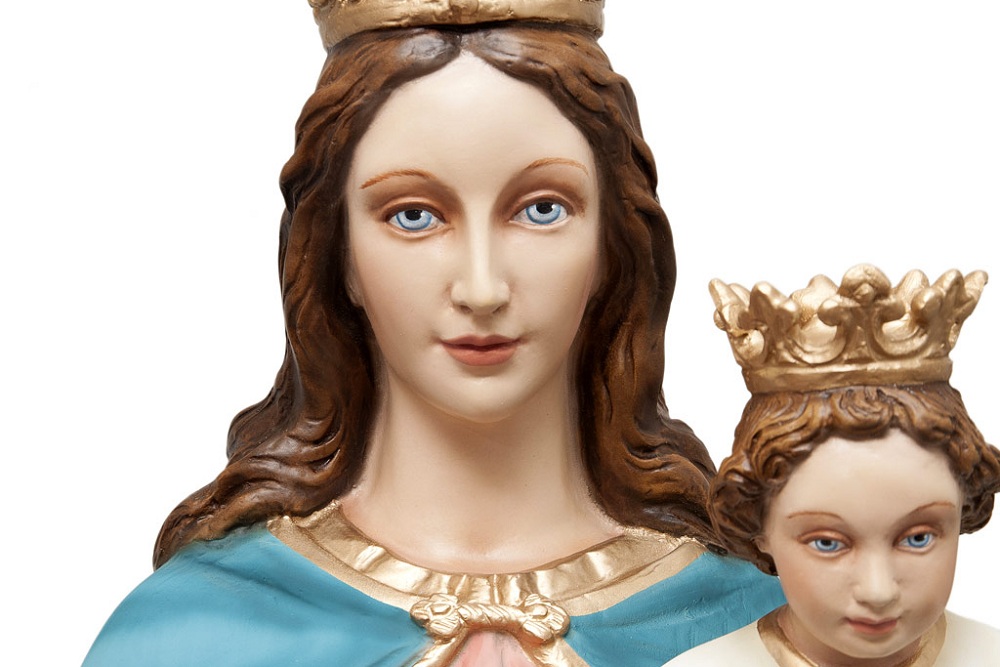
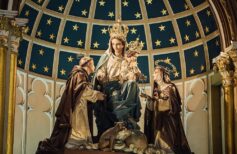
In 1875 he purchased a modest painting of Our Lady of the Rosary, the icon that would become the heart of the Sanctuary of Pompeii. Miracles began immediately to multiply. Humble folk and the powerful, the desperate and the noble, all flocked to Pompeii in search of grace, of a sign.
The partnership between Bartolo Longo and Countess Marianna changed forever the history of Pompeii. It was she who donated the land on which the future sanctuary would rise. Together they fought against misery and superstition, entrusting every effort and every dream to Our Lady of Pompeii, Mother of wounded souls. In time, their bond grew even stronger: at the counsel of Pope Leo XIII, in 1885 Bartolo and Marianna married, consecrating their union not to earthly love, but to a shared mission of good. They were spouses in chastity, companions in prayer, co-founders of immortal works.
From their combined strength were born not only the Sanctuary of Pompeii, but also institutions for orphans and the children of prisoners, schools for poor girls, hospices for the elderly and the sick. Every day, side by side, they faced toil and the scepticism of the world with the sole weapon of faith. The partnership between Bartolo Longo and Marianna Farnararo De Fusco was the lifeblood of a social miracle which still beats today in the heart of Pompeii. Without their meeting, perhaps the sanctuary would never have been built, the Supplica would never have found its voice, and the valley would have remained but a place of ruin and desolation.
The Supplica to Our Lady of the Rosary: The Heart of Devotion
Written in 1883, the Supplica to Our Lady of the Rosary of Pompeii is far more than a simple prayer: it is a collective voice which, each year, on 8 May and on the first Sunday of October, rises like a wave from the squares, from the homes, from the hearts of the people. In Pompeii, thousands gather before the sanctuary: some bring a secret sorrow, some a hope, some a whispered thanksgiving. The Supplica thus becomes a thread uniting generations and diverse stories, a plea for help and for entrustment to Mary, Mother and guardian of all who feel fragile.
In the text, real life can be felt beating: the trust of the simple, the weight of tears, the search for a protection which knows how to embrace everything. Every word of the Supplica is an open space where faith meets daily struggle and transforms it into hope.
It is not only a prayer, but an emotional wave crossing the centuries. Bartolo Longo wrote it kneeling, with his soul laid bare, offering to the Virgin his past of sorrow and his yearning to be reborn.
Some say that the notes of this Supplica, in the silence of the Sanctuary of Pompeii, seem to caress souls like a breeze rising from the Vesuvian plain. And it is true: those who listen, who pray, who entrust themselves, feel the presence of Bartolo Longo, a man become the voice of mercy, a poet of resurrected faith.
Bartolo Longo, Saint in the Jubilee 2025
The miracle of Pompeii, the rebirth of the city, the blossoming of charity, the prodigy of the Supplica, are today the stone upon which is founded the long-awaited announcement: Bartolo Longo will be proclaimed a saintduring the Jubilee 2025.
Read more:
The Jubilee 2025 Events Calendar
The calendar of events for the Jubilee 2025 has been published, twelve months of events and occasions…
Pope Francis, during his stay at the Agostino Gemelli Policlinic in Rome, had already recognised in the life of this “layman in love with the Rosary” a message of striking relevance. Bartolo Longo was not a priest, not a monk, he founded no orders, but he revolutionised history from below, with the quiet force of faith and the tenacity of one who has risen again from the blackest sin. The canonisation, which will take place during the Holy Year, will be a feast for all Pompeii and for all those, worldwide, who have invoked prayer through Bartolo Longo. It will be the triumph of mercy over every judgement, the demonstration that no downfall is definitive, that even from the depths of the abyss a saint may arise. Bartolo Longo, saint in the Jubilee 2025, is the story of a second chance offered to all, the echo of a voice that continues to say: “No one is lost, as long as there is a Mother who prays.”
O Blessed Bartolo Longo, who loved Mary with the tenderness of a son and spread devotion to her through the recitation of the Holy Rosary, and through her intercession received abundant grace to love and serve Christ in abandoned childhood, obtain for us the grace to live in a spirit of prayer united with God, to love Him as you did in our brothers and sisters.
You, who at the end of your earthly pilgrimage declared never to have tired of praying for every sorrow, for every anguish, for every calamity, trusting in the omnipotence of God and in the intercession of His Divine Mother, continue to intercede for all those who are called to carry on your work of faith and love in Pompeii and for all Rosary devotees throughout the world.
Obtain for us that, after the earthly contemplation of the joyful and sorrowful mysteries, we may, together with you and with Mary, Queen of Angels and of Saints, share the joy of the glorious mysteries in heaven. Amen.
The chrism mass celebrates the mystery of the church, its unity and communion while waiting for Easter. It is also...
What’s the Future of Religion?
What’s the Future of Religion?
A Beginner’s Guide to Christianity
A Beginner’s Guide to Christianity
Mind-Blowing Statistics About Christianity You Need to Know
Mind-Blowing Statistics About Christianity You Need to Know
7177
Enter the Holyart world: $20 discount voucher valid on over 60,000 items
Come and discover Holyart, the largest e-commerce of religious articles in Europe and immediately receive a $20 voucher to use with your first purchase.
Check your mailbox: you will receive your discount within 5 minutes






 4 March 2026